PSL Venue Scorecard: What Went on the Big Screen at Gaddafi Stadium
What went on the Gaddafi Stadium big screen in PSL 11, why a venue scorecard is built differently from a TV score bug, and how it runs off live scoring.
PSL Venue Scorecard
What Went on the Big Screen at Gaddafi Stadium in March-April 2026
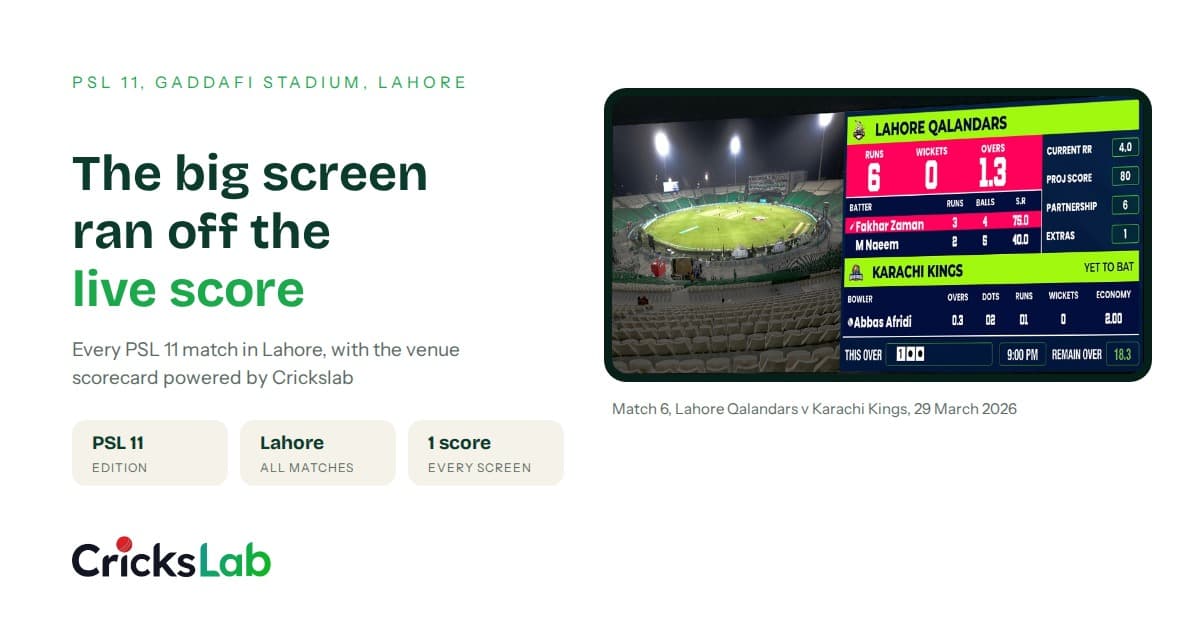
29 March 2026. Gaddafi Stadium, Lahore. The clock on the big screen says 9:00 PM.
Lahore Qalandars are 6 without loss after 1.3 overs. Fakhar Zaman has 3 off 4. Abbas Afridi has bowled three balls for one run.
The stands are empty. PSL11 played its league stage behind closed doors.
The screen is still working, because somebody is still watching it.
Who reads a venue scorecard
On a normal night, the crowd.
But a big screen has other readers too. The batters glance at it between balls. Fielding captains check the run rate. Umpires and match officials use it. And the TV cameras catch it in wide shots all night, so millions see it at home without ever noticing.
When PSL11 moved to Lahore and Karachi only, and the league stage went behind closed doors, those readers didn’t go anywhere. Then fans came back for the playoffs and the final, and the big screen had its full audience again.
For PSL11, the venue scorecard at every Lahore match ran on Crickslab.
A big screen is not a big TV
It’s tempting to take the TV score bug and blow it up. That doesn’t work.
A TV graphic is read from two metres away, for two seconds, on a screen someone is already staring at. A venue scorecard is read from the far side of a stadium, by someone who looked up between deliveries.
So everything changes.
The numbers get huge. Runs, wickets and overs sit in one block you can read from the top tier.
The colour blocks do the work. Batting side on one band, the side yet to bat on another, the bowler below. You know where to look before you can read the words.
There’s more context, not less. A TV bug can lean on the commentators. A big screen has nobody explaining it, so it carries the extra numbers itself.
What was on the screen
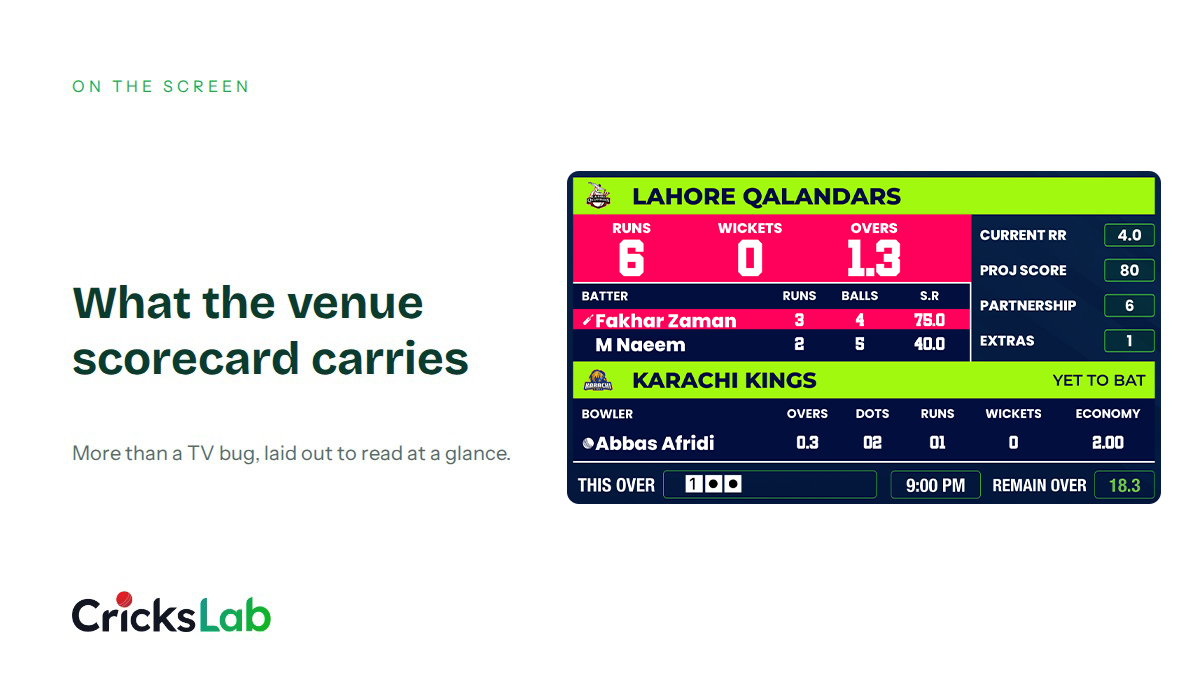
Here’s everything the Gaddafi Stadium scorecard showed at that moment in match 6:
The batting side, with runs, wickets and overs.
Both batters, with runs, balls faced and strike rate, and a marker on the one facing.
Current run rate, projected score, the partnership and extras.
The team yet to bat.
The bowler, with overs, dot balls, runs, wickets and economy.
This over, ball by ball.
The time and the overs remaining.
Every number came from one tap
This is the part people don’t see.
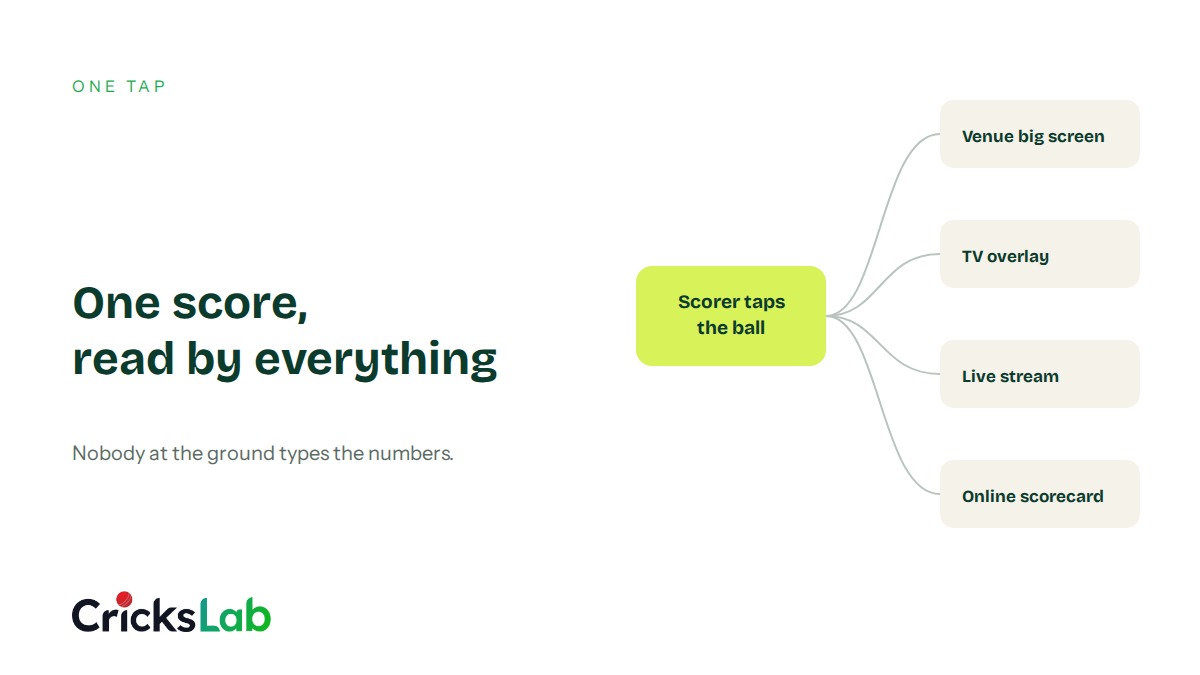
Nobody at Gaddafi Stadium was typing those numbers into the screen. The scorer recorded each ball once. The big screen, the strike rates, the projected score and the dot ball count all updated from that one record.
That matters on a night like 29 March. The projected score said 80 after 1.3 overs. Lahore finished on 128 for 9, and Karachi Kings chased it down with three balls to spare. On a tight chase, every number on that screen changes every ball, and a screen that runs behind the field is worse than no screen at all.
It’s the same idea behind live streaming and graphics on Crickslab. One score, read by everything. The TV overlay, the stream and the stadium screen can’t disagree, because there’s only one score for them to read.
What a venue scorecard needs to get right
If you run a ground, a league or a tournament with a big screen, these are the things that matter.
Readable from the back row. Big figures, strong colour bands, no small print in the parts that change most.
Updated off the live score. If someone has to type it, it will fall behind the field. It always does.
Enough context to stand alone. Run rate, projected score, partnership and the bowler’s figures. No commentator will be explaining it.
The same data as everything else. The screen, the broadcast and the scorecard online should all come from one source.
You don’t need a PSL stadium for this. The same ground screen scorecard runs on a club ground’s LED board or a school’s TV on a stand. It’s part of our broadcaster plans, and it shares the same feed as the broadcast graphics.
The screen nobody notices
A good venue screen scorecard is one nobody talks about.
The crowd looks up, gets the score, and goes back to the cricket. The batter checks the rate and gets on with it. The camera catches it in a wide shot and nobody at home thinks twice.
That’s the job: every ball, every match, all season.
Want your ground’s big screen running off the live score? Book a demo and we’ll show you how it’s set up.
Frequently asked questions
What is a venue scorecard in cricket?
A venue scorecard is the live score shown on a ground's big screen. It shows the batting side's runs, wickets and overs, both batters, the bowler's figures, the run rate, the partnership and the current over. It is laid out so people can read it from anywhere in the stadium.
Who ran the PSL11 venue scorecard at Gaddafi Stadium?
Crickslab ran the venue scorecard on the Gaddafi Stadium big screen for every Lahore match of PSL11 in 2026. Every number on the screen updated from the live ball by ball score.
How is a venue scorecard different from a TV score bug?
People watch a TV score bug from two metres away, with commentators explaining it. A venue scorecard is read from the far side of a stadium between deliveries. So it uses bigger figures, strong colour blocks and more context, such as the projected score, the partnership and the bowler's full figures.
How does the big screen scorecard update during a match?
The scorer records each ball once in Crickslab. The big screen, the TV overlay, the live stream and the online scorecard all update from that same record. Nobody types numbers into the screen, so it never falls behind the field.
Can a club or school ground use a venue scorecard like the PSL?
Yes. The same ground screen scorecard runs on a club ground's LED board or on a TV on a stand at a school ground. It comes with Crickslab broadcaster plans, which start at 29 dollars a month.