For regional and national cricket associations
Cricket association management software
An association sits between the clubs and the board. It has to hold the member register, sanction the competitions, appoint the officials, publish the results and then account for all of it upward. Most cricket software is built for a single club running its own fixtures, so an association ends up holding the structure together in spreadsheets.
Crickslab is built the other way round. The association is the top of the tree, the clubs sit under it, and every registration, fixture and result rolls up automatically. It is the same platform national boards run on, including the Pakistan Cricket Board at registration.pcb.com.pk, so an association is not being asked to trust software that has only ever run club cricket.
Where club software stops and association software starts
A club platform answers one question: what is my club doing this season. An association has to answer a harder set.
- Who are my member clubs this season, and which ones have not completed registration?
- Which players are registered, to which club, and are any of them registered twice?
- Which officials are accredited, when does that accreditation lapse, and who is available on Saturday?
- Which competitions have I sanctioned, across how many divisions and age groups?
- What are the current standings in each of them, calculated the same way, without anyone retyping a result?
- What do I send to the board at the end of the season, and can I evidence it?
Club software cannot answer these because the club is the ceiling. Every time an association tries, it rebuilds the association layer by hand in a spreadsheet, and the spreadsheet becomes the real system of record while the software becomes a scoring app.
One member register for the whole association
Every club, team, player, official and ground in the association exists once, in one register, with one identity. A player who moves from one member club to another keeps the same record and the same career history. The association sees the transfer rather than discovering a duplicate at the end of the season.
Registration runs through the association's own forms. You decide what is mandatory: date of birth, proof of age, photograph, medical consent, parental consent for junior cricket, club affiliation, fee status. A registration is not complete until your conditions are met, so eligibility is enforced at the point of entry instead of being argued about after a protest.
What this changes in practice
- Eligibility disputes are settled from the register, not from email.
- Age group cricket can be checked against a recorded date of birth.
- Officials show as accredited or lapsed, so appointments are defensible.
- The association can see registration completion by club, in real time, during the registration window when it can still do something about it.
Competitions the way an association actually runs them
An association rarely runs one league. It runs a senior division structure with promotion and relegation, a second XI competition, a limited overs cup on a knockout draw, junior age groups, and often a women's competition on a different calendar. These have different points systems, different over limits, different eligibility rules and different finals formats.
Crickslab holds all of them under one association, each with its own configuration. Points, bonus points, net run rate, quotient, penalties and tie breaks are set per competition and calculated automatically from the scorecard. Standings update when the match is confirmed. Nobody maintains a table by hand.
Fixtures can be generated for a round robin, a multi division ladder, a group and knockout draw or a pool format, with ground availability and club preferences taken into account. Rescheduling a washed out fixture updates the tables, the ground booking and the official appointments together.
Officials, appointments and match day control
Umpires and scorers are held in the same register as everyone else, with their accreditation level and availability. Appointments are made against fixtures, so an association can see the whole round at once and find the gaps before Friday night rather than on Saturday morning.
On match day the scorer works in the Crickslab live scoring app, ball by ball, online or offline. When the connection returns the match syncs. The association does not collect result cards. The result is already in the system, the table has already moved, and the player statistics have already updated.
Sanction competitions you do not run yourself
Associations sanction a lot of cricket they do not operate day to day: a district league, an age group tournament, a corporate competition on association grounds. The results, player appearances and disciplinary records from all of it still belong in the association's own records.
Crickslab handles this with delegated administration. The association creates the competition, sets the playing conditions and the eligibility rules, then hands operational control to the organiser. The organiser runs fixtures and scoring. The data lands in the association's register, under the association's rules, without the association running every round.
Eligibility is checked before the match, not after the protest
Age limits, residency conditions, registration cutoffs, overseas player quotas and suspension periods usually live in a regulations PDF and get checked when somebody complains. Crickslab checks them at team sheet submission. A player outside the age band for that competition, serving a suspension, or registered after the cutoff stops the team sheet from submitting clean. The association finds out on Friday night rather than at a hearing six weeks later.
Grounds allocated against competing demands
An association usually has fewer grounds than fixtures, and does not always own the ones it uses. The ground inventory, the availability calendar and the fixture allocation sit together, so a double booking is a validation error at scheduling time rather than a phone call on the morning of the match. Associations that hire grounds out can add the ground booking module on the same inventory.
White label, so it is the association's platform
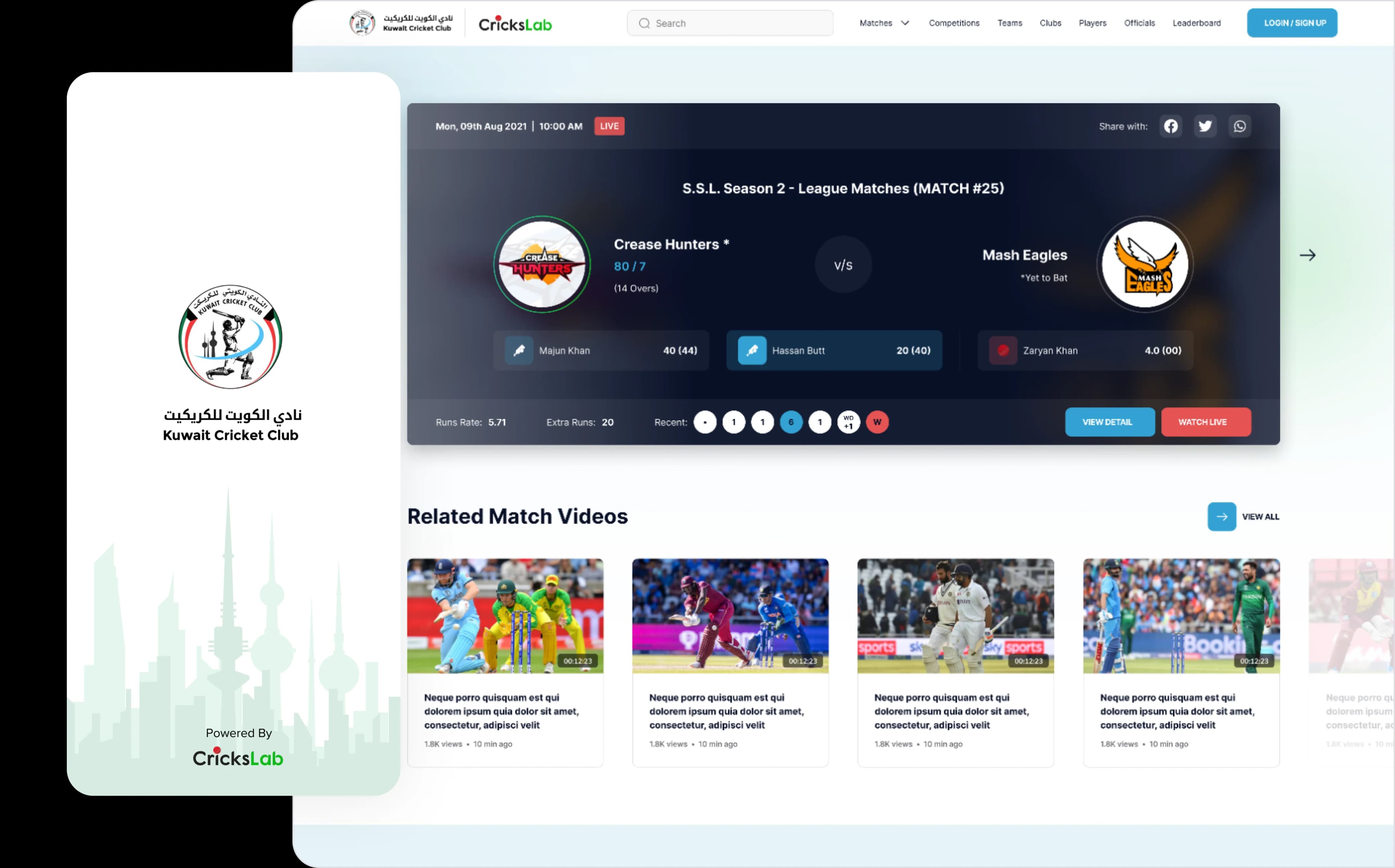
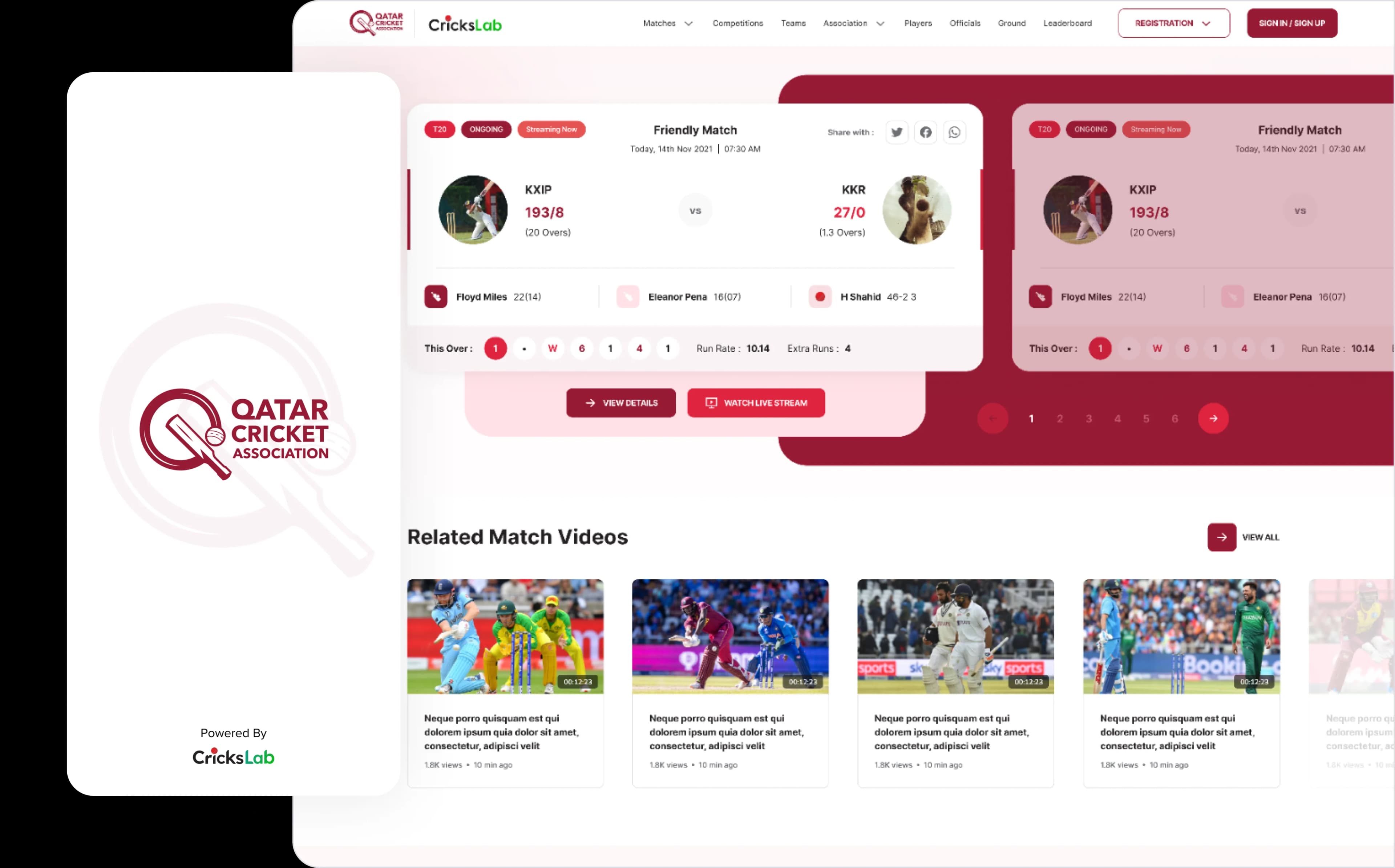
An association's members should see the association's brand, not a software vendor's. Crickslab runs white label on the association's own domain, with its own logo, colours and public site. The Qatar Cricket Association runs on qca.crickslab.com. The Pakistan Cricket Board runs registration at registration.pcb.com.pk.
That covers the public fixtures and results site, the registration portal, the mobile experience and the emails that go to clubs and players. Sponsors can be carried on the association's own property, which for many associations is the part that pays for the platform.
Reporting upward, and the audit trail
Associations answer to a board, and often to a funder or a government sports body. Participation numbers, junior and women's registration, club counts, match counts, ground utilisation and official appointments are all already in the system because they are byproducts of running the season, not a separate data collection exercise.
Every registration, approval, appointment, result confirmation and edit is recorded with a user and a timestamp. When a result is challenged, or when a funder asks how a participation number was arrived at, the answer is in the record.
Associations and boards already running on Crickslab
Crickslab is used by the Pakistan Cricket Board, the Bangladesh Cricket Board, Kuwait Cricket, the Qatar Cricket Association and the Italian Cricket Federation, and by Lahore Qalandars, Dialog and T Sports.
Kuwait Cricket and the Qatar Cricket Association are the closest reference points for most associations. Both run a full domestic structure, multiple divisions, their own registration and their own public site, and both are smaller and more resource constrained than a Test playing board. The association layer was not adapted from club software for them. It is what the platform was built to do.
These deployments are referenceable. If you want to speak to one of them before you commit to anything, ask on the first call and we will arrange it.

Kuwait Cricket
National body, Kuwait
- Matches
- 10k+
- Competitions
- 200+
- Teams
- 1k+
- Players
- 15k+

Qatar Cricket Association
National association, Qatar
- Matches
- 1k+
- Competitions
- 100+
- Teams
- 500+
- Players
- 7k+

Italian Cricket Federation
National federation, Italy
- Matches
- 2k+
- Competitions
- 100+
- Teams
- 100+
- Players
- 5k+
If you are a national board or federation rather than an association, the tier above this one is covered on the cricket board management software page.
Where Crickslab is not the answer
If you are a single club running one senior side and two junior teams, this is more system than you need. The eligibility engine, delegated administration and the officials workflow are all overhead when there is no association layer above you, and the club product is the better fit.
Crickslab is worth the change when you sit above clubs and are accountable for the whole competition.
Moving from what you have now
Most associations arriving here are running one of four things: a club platform stretched past what it was designed for, a set of spreadsheets, a website built by a volunteer, or a platform that has been discontinued.
Crickslab imports clubs, teams, players, historical fixtures and historical results. Player career records survive the move, which for an association with a long history is usually the sticking point. Migration is scoped before anything is committed, and it is run against a copy first so you can see your own data in the system before you switch.
A typical association goes live in six to eight weeks, with the current season first and history backfilled behind it. Your data stays yours: full export in a documented format at any time while you are a customer, and on the way out if you ever leave.
If you are coming off CricHQ, which has been unreachable since August 2024, see the CricHQ alternative page for what can and cannot be recovered.
What it costs
Association pricing depends on the number of member clubs, the number of registered players and whether you take white label, streaming or ticketing. It is quoted per season, not per user, so an association is not penalised for adding volunteers or officials to the system.
We do not publish a single association price because a nine club association and a two hundred club association are not the same product. We do give a figure on the first call rather than after a discovery process.
What we will ask you on the first call
How many member clubs, and how many teams across all of them. How many registered players, split senior and junior. How many competitions, and how many divisions inside them. Whether you appoint officials centrally. Whether you need your own domain and brand. What you are running now, and how much history you want to bring across. Whether you report participation numbers to a board or a funder.
That is enough to price it and to tell you whether it will work, in one call.
Talk to our team
See it run against your own competition structure
The useful demo is not a feature tour. It is Crickslab configured against your divisions, your registration conditions and your reporting obligations, so you can judge it on your own cricket.